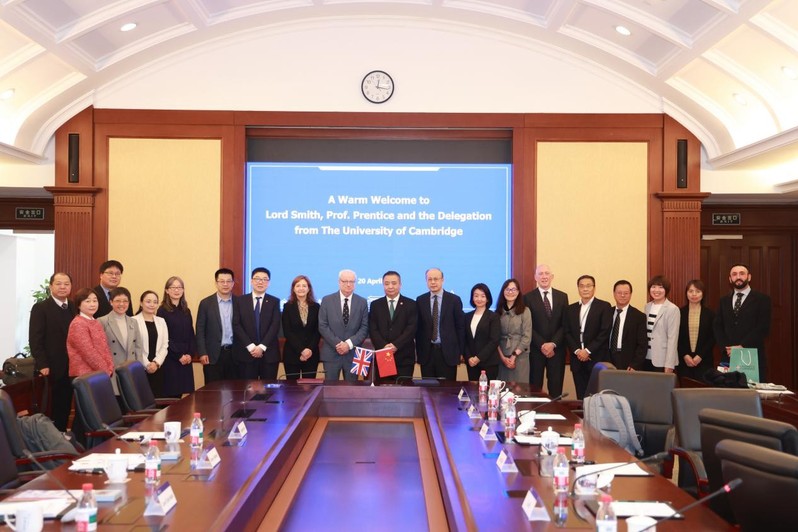
April 20 — Jin Li, President of Fudan University and Member of the Chinese Academy of Sciences, met with a delegation from University of Cambridge led by Lord Chris Smith, Chancellor of the University of Cambridge, and Deborah Prentice, Vice-Chancellor. The two sides exchanged views on further expanding academic and educational collaboration and renewed the inter-university Memorandum of Understanding. Chen Zhimin, Vice President of Fudan University, attended the meeting.
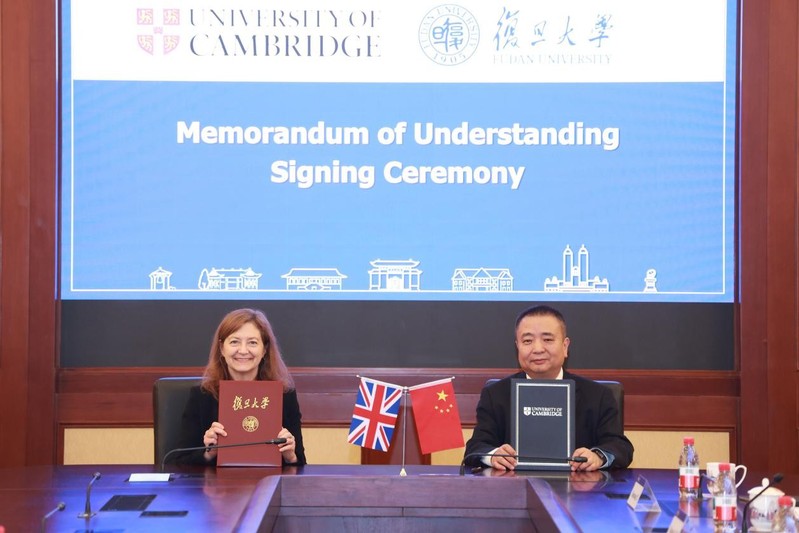
On the same day, the Center for Advancing Global Collaboration at Fudan University signed a collaboration agreement with Fitzwilliam College Cambridge. Under the agreement, the two sides will carry out initiatives including student exchange programs for Fudan students, participation in the “Fitz Education” program, and opportunities for Fudan scholars to serve as visiting fellows at the College.
Lord Smith expressed his appreciation for the warm reception by Fudan University. He noted that choosing Fudan as the first stop of the Cambridge delegation’s visit to China reflects the high importance Cambridge attaches to the partnership. He highlighted the significant achievements made through years of collaboration and expressed his expectation to further deepen joint research in areas such as global humanities and medical and health sciences.
Prentice stated that the two universities have already established strong cooperation in fields including the humanities, life sciences, medical and health sciences, and neuroscience, with potential to expand into more frontier areas in the future. She expressed her hope to consolidate existing collaboration while exploring new areas of partnership.
On behalf of the University, Jin Li extended his welcome to Smith, Prentice, and their delegation. He noted the deep-rooted partnership between Fudan and Cambridge. Since the signing of the Memorandum of Understanding in 2019, collaboration between the two institutions has progressed steadily, with extensive academic exchanges in areas such as global humanities, brain-inspired intelligence, and cognitive neuroscience. Looking ahead, he expressed hope that the two universities will make further progress in three key areas: first, strengthening talent cultivation and academic exchange by expanding faculty and student mobility, exploring joint training mechanisms, and fostering engagement among early-career scholars; second, deepening interdisciplinary research collaboration by developing new joint platforms and projects, supported by robust institutional frameworks; and third, enhancing the global impact of the partnership by jointly contributing to international academic dialogue, scientific innovation, and addressing shared challenges facing humanity. He expressed his expectation to work with Cambridge to elevate the partnership to a new level.
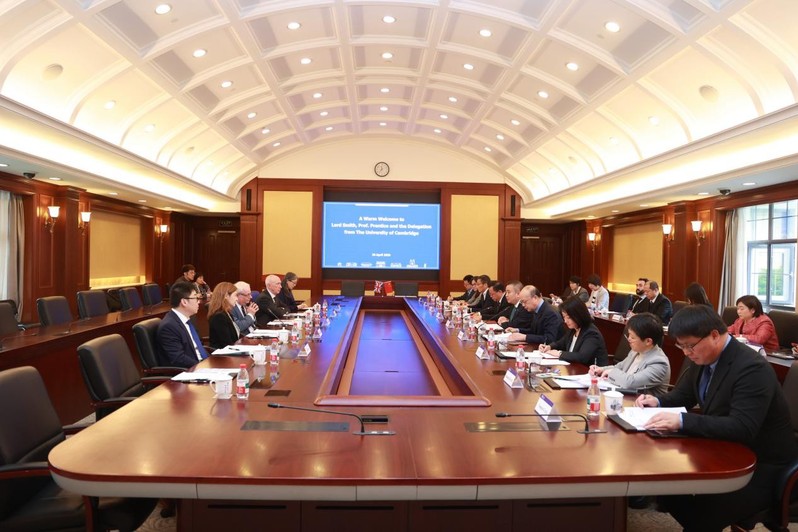
Representatives from relevant faculties and departments of both universities attended the meeting and participated in discussions.
In the afternoon, a delegation led by Baroness Sally Morgan, Master of Fitzwilliam College and Chair of the Cambridge University Hospitals NHS Foundation Trust, visited the Fudan University Shanghai Cancer Center. David Cardwell, Fellow of Fitzwilliam College and Professor of Superconducting Engineering at the University of Cambridge, delivered a lecture titled “Bulk Superconductors: Revolution or Red Herring?” at the Yuan·Chuang Center for Fudan faculty and students.
Founded in 1209, the University of Cambridge is the fourth-oldest surviving university in the world and one of the world’s leading public research universities. It is a core member of the UK’s G5 group of elite universities and the Russell Group.
Established in 1869, Fitzwilliam College is one of the 31 colleges of the University of Cambridge. Known for its strong academic tradition, it has educated numerous Nobel laureates. Its motto, “Ex antiquis et novissimis optima,” means “the best of the old and the new.”

Copyright © Center for Advancing Global Collaboration Fudan University
