The Fudan University–The Hong Kong Polytechnic University Shanghai–Hong Kong Joint Laboratory for AI in Healthcare was officially launched in Shanghai on September 21. The ceremony brought together university leaders, heads of relevant faculties and departments, and representatives of partner companies from Hong Kong. Jointly established by the two universities, the laboratory will focus on strategic interdisciplinary AI research in medicine and health.
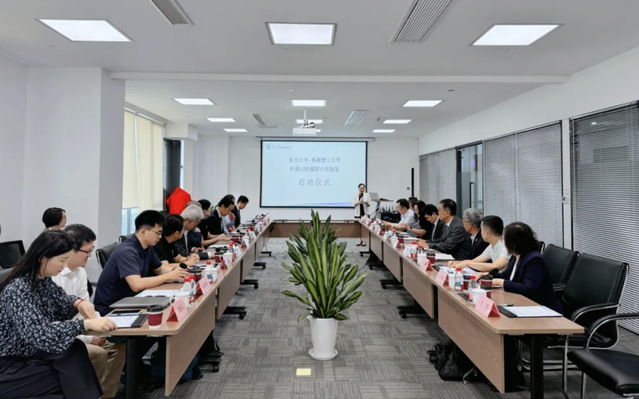
The convergence of artificial intelligence and the life and health sciences has become a strategic frontier in global scientific and technological competition, as well as a key priority in China’s innovation agenda. Shanghai is accelerating its development as a science and technology innovation center with global influence, while Hong Kong is advancing its role as an international innovation and technology center. Against this backdrop, Fudan University and The Hong Kong Polytechnic University (PolyU) have joined forces to establish the laboratory, combining Fudan’s longstanding expertise in infection and infectious diseases, clinical medicine, and public health with PolyU’s strengths in AI research. Building on the complementary advantages of Shanghai and Hong Kong, the partnership will connect innovation resources across the Yangtze River Delta and the Guangdong–Hong Kong–Macao Greater Bay Area.
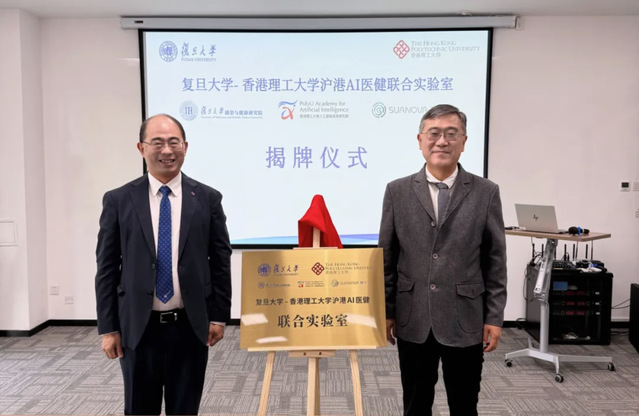
The launch ceremony was hosted by Yefang Xu, Deputy Director of Fudan University’s Center for Advancing Global Collaboration. In the presence of the assembled guests, Lei Zhou, Vice President of Fudan University, and Wing-tak Wong, Deputy President and Provost of PolyU, jointly unveiled the laboratory’s plaque, marking the formal launch of the two universities’ collaboration at the intersection of AI, medicine, and health.
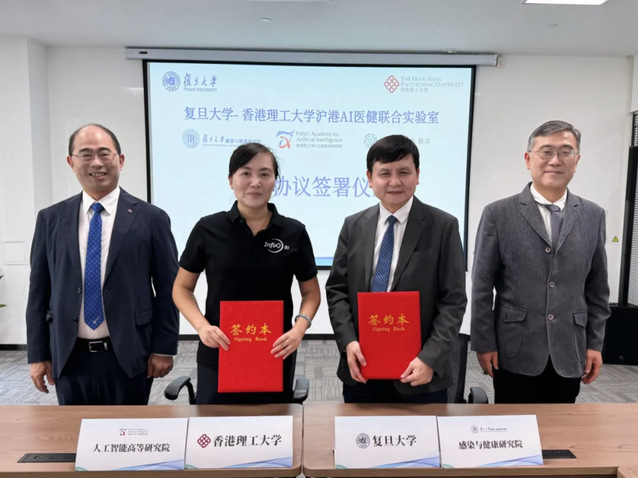
Following the unveiling, Wenhong Zhang, Dean of Fudan University’s Institute of Infection and Health, and Hongxia Yang, Executive Director of the PolyU Academy for AI, signed a cooperation agreement on behalf of the two institutions. The partners will jointly pursue key technology development and innovation in core algorithms, submit joint research proposals, establish innovation platforms, and translate research findings into practical applications. They will also collaborate on the training of postgraduate students, postdoctoral researchers, and early-career researchers, while promoting academic exchange.
The launch also included a donation ceremony to support the laboratory’s development. Representing the donor, Douglas Fang Yan Tak, Chairman of Hong Kong’s SUANOVA Group and Chairman of the Board of Yeebo (International Holdings) Limited, signed a donation agreement with Li Liu, President of the Fudan University Education Development Foundation (Overseas), witnessed by Zhou and Wong. On behalf of Fudan University, Zhou presented Fang with a plaque of appreciation in recognition of Hong Kong SUANOVA’s support for university basic research and education. Daliang Chen, Chief Executive Officer of SUANOVA, said the donation would support the laboratory’s development and help bring domestically developed computing technologies into healthcare applications.
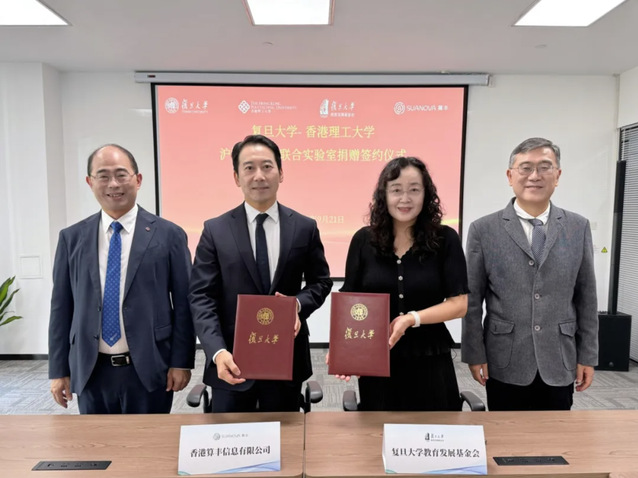
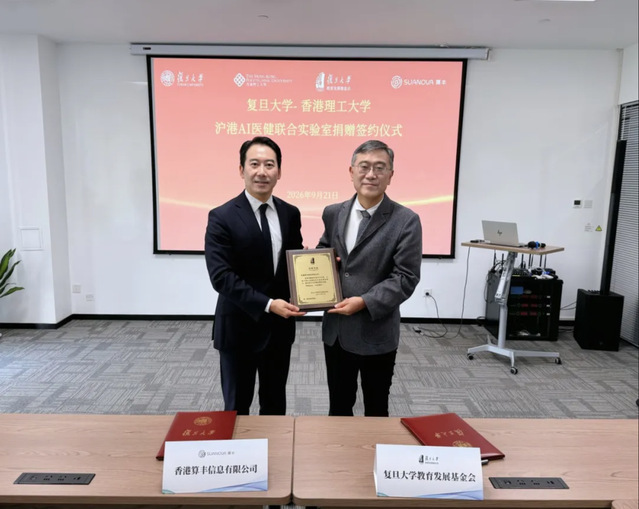
In his remarks, Zhou noted that AI is transforming the way scientific research is conducted, but that “tools alone do not produce answers.” In medicine, he said, the crucial test of innovation is whether it can connect real problems with new tools—a connection that will determine how far AI can advance in the field. He encouraged the laboratory to begin with genuine needs arising from frontline clinical practice and to let those needs guide technology development. He also pledged Fudan University’s full support for the laboratory, including the provision of necessary office and research space, experimental facilities, and resources for clinical research.
Wong said that PolyU had continued to strengthen its strategic commitment to AI in recent years, advancing both frontier research and practical applications. Fudan, meanwhile, brings extensive expertise in medicine, public health, and clinical research. Supported by leading research platforms such as the National Medical Center for Infectious Diseases, it has achieved significant results in the prevention and control of major infectious diseases and in healthcare research. The joint laboratory will further integrate AI technologies with medical, clinical, and public health needs, translating healthcare innovations with international impact into practical use.
Zhang noted that more than two years had passed between the initial discussions and the laboratory’s formal launch, during which scientists from both institutions had undertaken multiple reciprocal visits and exchanges. He outlined his team’s research priorities and plans, expressing the hope that the laboratory would deliver results at an early stage. Yang said that the partnership was founded on a shared ambition to achieve breakthroughs in domain-specific models and interdisciplinary research, while advancing the commercial application of research outcomes.
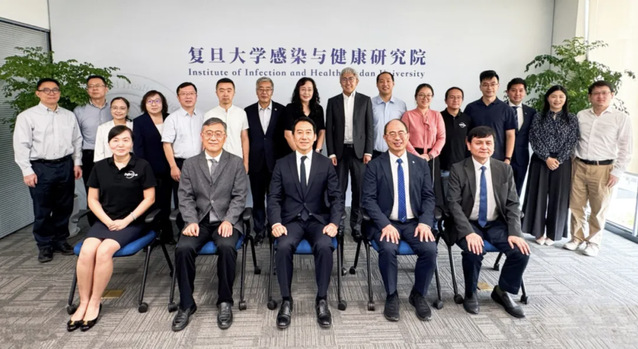
Building on this launch, the two universities will continue to deepen their collaboration and develop the laboratory into a flagship example of science and technology cooperation between Shanghai and Hong Kong. The integration of AI with the life and health sciences is becoming an important measure of regional innovation capacity. Guided by clinical needs, the laboratory will connect real challenges in frontline medical practice with cutting-edge AI technologies, ensuring that advances in research serve clinical care and improve people’s lives.

Copyright © Center for Advancing Global Collaboration Fudan University
