From July 5 to 8, Jin Li, President of Fudan University and an academician of the Chinese Academy of Sciences, led a delegation to Geneva, Switzerland, and Paris, France. During the visit, he attended the launch ceremony of the United Nations-supported Global Network of Centers for Exchange and Cooperation on AI Capacity Building, delivered a keynote address at the high-level seminar “AI for Good and for all,” visited the World Health Organization (WHO), the World Meteorological Organization (WMO), and the United Nations Educational, Scientific and Cultural Organization (UNESCO), paid a visit to the Permanent Mission of China to the United Nations Office at Geneva and other international organizations in Switzerland, and met with representatives of Fudan University’s Swiss Alumni Association.
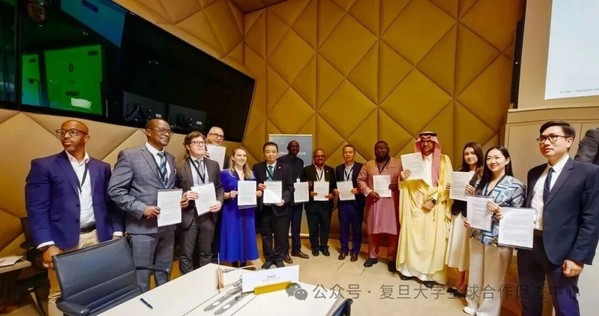
On July 5, the Global Network of Centers for Exchange and Cooperation on AI Capacity Building, established with support from the United Nations, was officially launched in Geneva. Responding to the Global Digital Compact and the recommendations in the UN Secretary-General’s report on innovative voluntary financing options for artificial intelligence capacity-building, the Network seeks to pool expertise, resources, and capabilities worldwide through international cooperation and the provision of public goods. Working through a network-based model, it aims to advance AI capacity-building. Its founding members span four continents and include institutions from 19 countries and international organizations.
As the representative institution from China, Fudan University’s Center for Global AI Innovative Governance played a leading role in establishing the Network. The Center undertook key institutional planning tasks, including operating the interim secretariat and drafting the Network’s governing documents, incorporating Chinese experience and Shanghai practices into its institutional design. President Jin Li formally signed the cooperation framework on behalf of the Center, marking its entry into the Network.
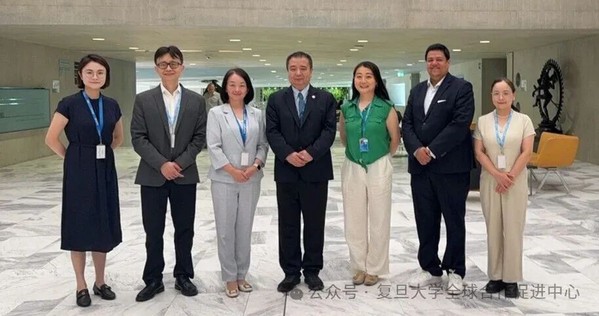
On July 6, the delegation visited WHO and held discussions with its Department of Digital Health and Innovation. The two sides exchanged views on governance frameworks, data standards, and ethical guidelines for the use of AI in global health. WHO representatives outlined the Organization’s forward-looking work on AI governance and the overall framework of the Global Initiative on AI for Health (GI-AI4H). Fudan University shared its experience in implementing an AI strategy across all disciplines, standardizing life sciences data, and developing healthcare applications of AI. Both sides agreed that ensuring AI serves the public good, promotes equity, and delivers lasting benefits is a shared challenge for the international community and requires sustained dialogue and collaboration.
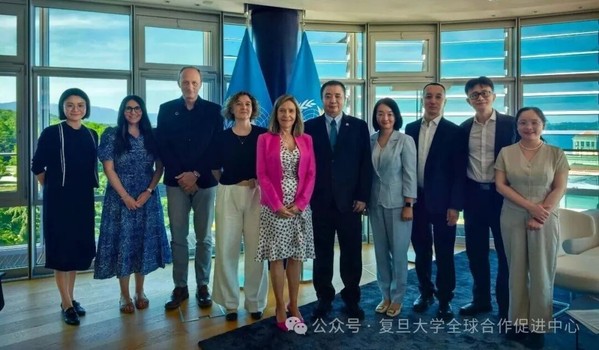
On the same day, the delegation visited WMO and met with Secretary-General Celeste Saulo. The two sides reviewed the progress made since the MAP-AQ Asia Regional Office was established at Fudan University in 2019 and since they signed a memorandum of understanding in 2024. They reached a consensus on deepening cooperation in frontier areas including AI-enabled meteorological services, space sustainability, interdisciplinary research on climate and health, and global capacity-building. WMO commended Fudan University’s contributions to developing its international summer school program and cultivating globally minded talent. The two sides agreed to further expand cooperation in open science, strengthen the joint training of young leaders, and provide scientific and technological support for global climate governance and sustainable development.
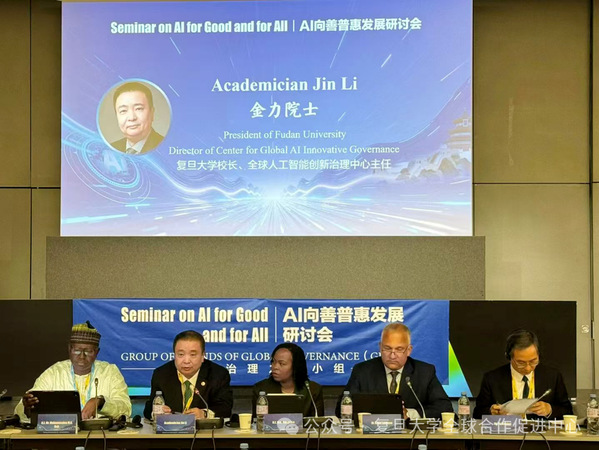
On July 7, President Jin Li delivered a keynote address at the high-level seminar “AI for Good and for all.” Organized by the Group of Friends of Global Governance in Geneva during the inaugural Global Dialogue on Artificial Intelligence Governance and the AI for Good Global Summit, the seminar brought together approximately 200 representatives of Member States, leaders of international organizations, and scholars from think tanks.
President Jin noted that the AI divide has evolved from a gap in access into deeper, multidimensional disparities in computing power, data, talent, industrial ecosystems, and the capacity to participate in rulemaking. He proposed three pathways to bridge this divide: moving from access to effective use so that AI can be applied in real-world development settings; shifting cooperation from technology transfer to joint capacity-building, with an emphasis on cultivating interdisciplinary talent and sustainable capabilities; and advancing governance from one-way rulemaking to open collaboration, enabling countries of the Global South to participate in discussions on an equal footing.
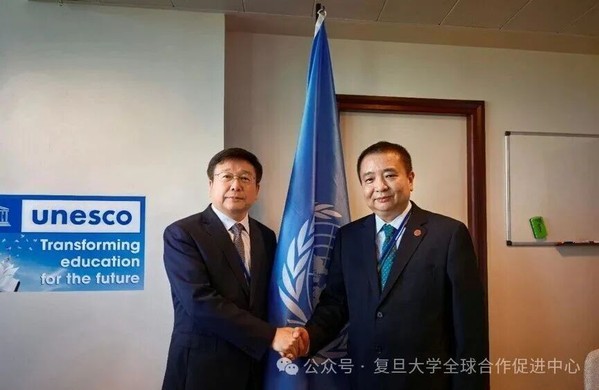
On July 8, the delegation visited UNESCO and held separate meetings with Qun Chen, UNESCO Assistant Director-General for Education; the Division for the Future of Learning and Innovation in the Education Sector; and the Division of Science Policy and Basic Sciences in the Natural Sciences Sector. The discussions covered the development of UNESCO Chairs and UNITWIN Networks, AI-enabled education, the ethics of science and technology, and global education governance.
UNESCO representatives commended Fudan University’s forward-looking initiatives in AI education, interdisciplinary talent development, and research on the ethics of science and technology. They expressed a willingness to maintain active engagement with Fudan and looked forward to the University contributing the knowledge and experience of Chinese academia to innovation in AI-enabled education, research on scientific and technological ethics, and the design of the global education agenda.
While in Paris, the delegation also visited Sciences Po. The two sides exchanged views on cooperation in climate change, AI governance, and sustainable development, with Sciences Po introducing its newly established Paris Climate School. They also explored the possibility of developing an online joint course on cultural heritage conservation and establishing a trilateral cooperation mechanism.
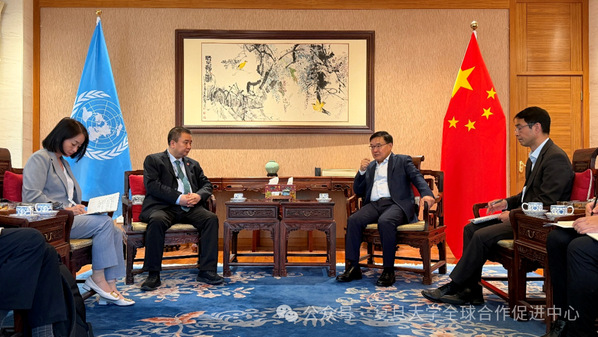
During the visit, President Jin and his delegation met with Ambassador Jia Guide at the Permanent Mission of China to the United Nations Office at Geneva and other international organizations in Switzerland. They exchanged views on global AI governance and the development of talent for international organizations. The delegation also met with representatives of Fudan University’s Swiss Alumni Association. President Jin expressed the hope that overseas alumni would continue to support the University’s development and contribute ideas and advice on Fudan’s internationalization and the cultivation of talent for international organizations.
Mei Tian, Director of the Center for Advancing Global Collaboration and Dean of the Human Phenome Institute, and Binzhi Qian, Vice Dean of the Human Phenome Institute, were among the Fudan representatives accompanying the delegation. Representatives of the Fudan Development Institute, the Department of Tourism, and the Space Internet Research Institute participated in selected engagements.

Copyright © Center for Advancing Global Collaboration Fudan University
